31 August 2026
Five Bottles Under the Sink: Why One Cleaner Can't Do Everything
This article contains affiliate links. If you buy through them I earn a small commission, at no extra cost to you. It doesn't change what I recommend.
Open the cupboard under your sink and count what’s in there. Most people find five or six bottles, half of them nearly empty, two of them bought for the same job, and one whose label came off years ago.
And still, when the hob is covered in cooked-on grease after Sunday lunch, none of them quite does it.
That isn’t bad luck, and it isn’t you buying the wrong brands. It’s chemistry. The dirt in a kitchen and the dirt in a bathroom are not the same substance, and they don’t come off the same way.
Grease and limescale are opposites
Cooking grease is fat. Fat dissolves in alkaline conditions — that’s the whole principle behind soap, and it’s why degreasers and oven cleaners sit high on the pH scale. The alkali breaks fat into pieces that water can carry away.
Limescale is the opposite problem. It’s calcium carbonate, left behind when hard water evaporates on a shower screen or around a tap. Calcium carbonate doesn’t care about alkali at all — it dissolves in acid. That’s why your grandmother’s vinegar worked on the kettle and why bathroom products lean acidic.
Put those two facts together and you get the thing nobody tells you when you’re buying a “universal” spray: a product that’s genuinely good at grease is, by its nature, poor at limescale, and the reverse. Acid and alkali cancel each other out. A single bottle that claimed to be excellent at both would be telling you it is fairly weak at each.
That’s the reason a cleaning cupboard has more than one bottle. Not marketing. Chemistry.
The map: seven jobs, not seven brands
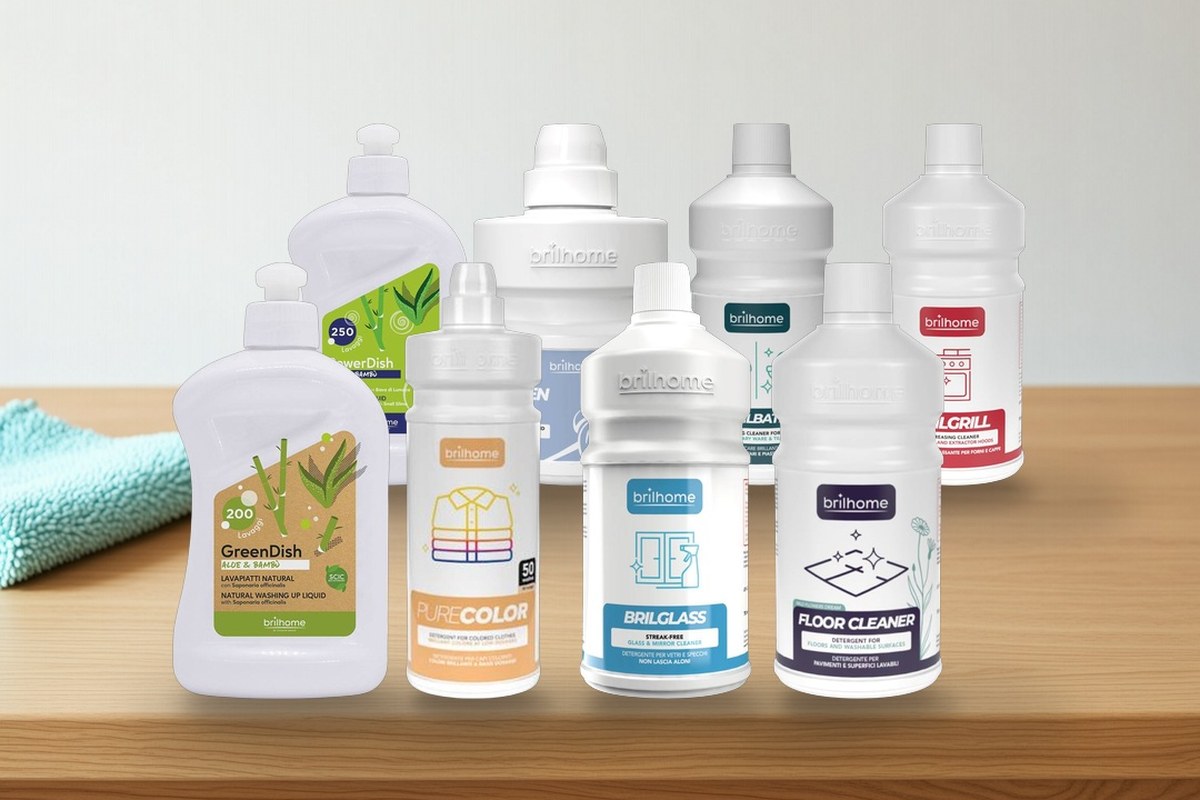
Once you sort by job rather than by brand, the cupboard shrinks instead of growing — because you stop buying three variations of the same thing. The Italian line I use, Brilhome, is organised exactly this way, and the structure is worth borrowing whatever you buy:
- Dishes. Washing-up liquid, and that’s it. The number worth checking here is washes per bottle, not millilitres — more on that below.
- Laundry. A softener, plus separate detergents for white, colour and black.
- Bathroom. Limescale on tiles and taps, and separately the drains.
- Glass and mirrors. The one job where the goal isn’t “clean” but “no streaks”.
- Appliances. Oven and extractor hood, stainless steel, and the coffee machine — three genuinely different problems.
- Floors. Tiles and sealed surfaces on one hand, parquet on the other.
- The fireplace. Soot on the glass, if you have one — a seasonal job, and a chemically separate one.
- Tools. Microfibre cloths and a spray bottle, which do more than most people expect.
Eight sections, and in the Brilhome catalogue forty-nine products fill them. You don’t need forty-nine. You need to know which of the eight you actually run into every week.
Why laundry splits into three
This is the part people resist most: separate detergents for white, coloured and black clothes look like an invented reason to sell three bottles. They aren’t.
White fabric is fighting yellowing, so those detergents carry optical brighteners and bleaching agents. Colour is fighting the opposite — dye leaching out of the fibre — so those formulas leave the brighteners out and add ingredients that keep the dye in place. Black has a third problem again: it doesn’t fade so much as go grey, because detergent residue and lifted fibres scatter light on the surface.
Use a whitening detergent on a black shirt for a season and you will watch it turn a tired charcoal. It isn’t the washing machine.
Two numbers on the Brilhome laundry bottles are worth knowing: they’re formulated to work at 30 °C, and the recommended dose is half what you’d use of a standard detergent. That combination — colder water, less product — is where the actual saving is, not in the price of the bottle.
“250 washes” is the number that matters
On a washing-up liquid, the front of the bottle usually shouts about volume. Volume tells you very little, because concentration varies enormously.
PowerDish is 500 ml and rated at 250 washes; the plant-based GreenDish version, made with soapwort extract, is rated at 200. That’s the figure to compare between brands, and it’s the reason a concentrate that looks expensive on the shelf is often the cheaper bottle in the drawer.
There’s a technique that goes with it. Concentrate belongs in the water, not on the sponge. Squeezing it straight onto a sponge means you use several times the dose, rinse most of it away unused, and leave the rest as a film on the plates. A few drops in the bowl does the same work.
The same logic runs through the surface cleaners: they’re diluted for everyday wiping and used neat only on something serious, like the hood filter after a fortnight of frying.
The mirror problem
Glass is the one surface where “more product” makes things worse, and it’s why people think mirror cleaners don’t work.
A streak is not dirt. It’s what’s left behind after the water evaporates: dissolved minerals from the tap, plus whatever surfactant hasn’t been carried away. Spray more cleaner on and you leave more residue, and the mirror looks worse than when you started.
Three things fix it, in this order: less product, a dry microfibre cloth for the second pass, and not doing it in direct sunlight — warm glass dries before you’ve finished wiping, and it dries in stripes.
Soot is a third kind of dirt
If you have a fireplace or a wood stove, its glass is the one surface in the house that no general cleaner touches — and it’s worth understanding why, because it explains the whole logic of this article in one example.
Soot isn’t grease and it isn’t limescale. It’s unburned carbon, bound up with tar and resin from the wood, and heat has baked the whole mixture onto the pane over a season of burning. An alkaline degreaser is built for soft fat. A descaler is an acid, built for mineral deposits. Neither is aimed at carbon fused to hot glass, which is why a kitchen spray on fireplace glass just moves the black around.
What works is a solvent formulated for that specific deposit — sprayed onto cold or barely warm glass, left to sit while it softens the film, then wiped off with a sponge. Heavy build-up usually needs a second pass, and that’s normal rather than a sign the product is weak.
Two practical notes, because both catch people out. Gloves are not optional here: a cleaner strong enough to dissolve baked carbon is strong enough to matter for skin. And these fireplace cleaners are often sold as concentrate refills, without a spray head — the trigger from an old bottle screws straight on, so don’t order a second product to solve that.
The timing is the part most people get wrong. This is an autumn job, done before the first fire of the season, while the fireplace is cold and empty. Mid-winter, with the stove warm and in daily use, there’s no good window to let a solvent sit.
What a household cleaner is not allowed to promise
Somewhere on the shelf there’s a bottle promising to kill 99.9% of germs, and it’s worth knowing what that claim means legally.
In the EU, a product sold on its ability to destroy micro-organisms is a biocide, and biocides fall under Regulation (EU) 528/2012: their active substances go through a separate approval process, the product is authorised, and the claim is registered. An ordinary detergent — however good — is not that, and cannot say it.
So when you’re comparing bottles, treat “kills bacteria” as a regulatory category rather than a quality rating. A cleaning product’s job is to lift dirt, grease and residue off a surface so water can take it away, and for a kitchen worktop after dinner that is precisely what you want. Manufacturers who use the word “sanitising” are describing their own product within their own paperwork; it isn’t a promise I’m in a position to repeat for them.
What’s actually worth having
If you’re rebuilding the cupboard from scratch, five bottles cover almost everything a home throws at you:
- A washing-up concentrate — the thing you touch every day.
- A degreaser for the hob, worktop and the front of the extractor hood.
- A limescale cleaner for the shower screen, tiles and taps.
- A glass cleaner, kept for glass and nothing else.
- A floor cleaner matched to your floor — tile and parquet want different things, and parquet is the one you can genuinely damage.
Then two things that aren’t bottles at all: several microfibre cloths, colour-coded by room so the bathroom cloth never meets the worktop, and a spray bottle for diluting concentrate, which is what makes the whole system cheaper than buying ready-mixed.
Everything beyond that is a specific problem you either have or don’t: caustic granules for a slow drain, a descaler for the coffee machine, a stainless steel polish if your kitchen is full of it.
One caution on the drain granules, since they’re the one genuinely hazardous thing in this list: they’re caustic. Gloves, no mixing with anything else, and they live on a high shelf away from children.
Start with the one you use daily
If all of this feels like a shopping list, it isn’t meant to be. The honest way in is to replace one bottle — the one you reach for most — and see whether the difference is real before touching the rest.
For most kitchens that’s the washing-up liquid or the degreaser. I’m going through the line one product at a time over the next week, showing each one doing the single job it was built for, and the ones below are where I’d start.