13 August 2026
Devil's Claw Ointment: What's in the Jar, and How It's Actually Used
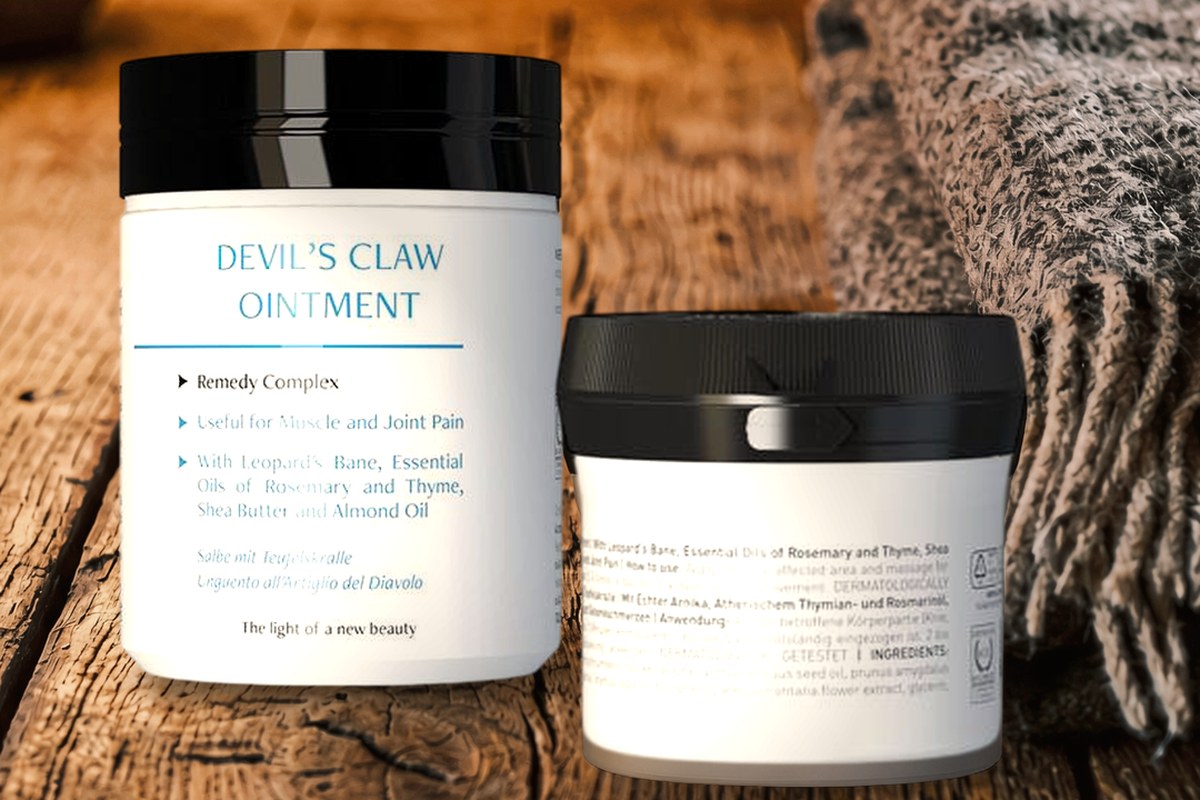
This article contains affiliate links. If you buy through them I earn a small commission, at no extra cost to you. It doesn't change what I recommend.
Most people use a jar like this the way they use hand cream. A dab, a quick rub, done in ten seconds, back in the drawer.
The instruction on the pack asks for something else: apply to the area, massage for about five minutes, until it is fully absorbed — and then cover the spot with a natural fibre cloth, cotton gauze or wool.
Five minutes is a long time when you are standing in a bathroom at eleven at night. It is also the whole difference between using this product and merely owning it.
The plant with the hooks
Devil’s claw is Harpagophytum procumbens, a low creeping plant from the Kalahari, in southern Africa. The name has nothing to do with what it does and everything to do with what it looks like: its fruit is covered in woody, curved hooks that catch in the hooves and fur of passing animals. Sailors and settlers called it the devil’s claw, and the name stuck across every language — Teufelskralle in German, artiglio del diavolo in Italian.
The part used isn’t the fruit but the root, which the plant stores underground as a thick tuber. In southern Africa it has a long history in traditional use, and in Europe it turned into an ingredient you meet in two very different places: in herbal preparations taken by mouth, and — as here — in balms applied to the skin.
That distinction matters more than it sounds, and we’ll come back to it.
What else is in the jar
The formula is short, which is a good sign in a balm:
- Shea butter and beeswax — the base. Together they make the texture dense: this holds its shape in the jar rather than pouring.
- Devil’s claw root extract — the ingredient the product is named for.
- Arnica montana — the yellow mountain flower that has been in massage balms for generations. You’ll see it on the label under its old English name, leopard’s bane.
- Essential oils of rosemary and thyme — they carry the scent, herbal and slightly sharp, nothing like a perfumed body cream.
- Sweet almond and sunflower oils, and vitamin E — the softening part, and what makes it spread under your hands for five minutes without dragging.
No water. That is why it is an ointment and not a cream, and it explains most of how it behaves.
Why it’s thick, and why winter changes it
A cream is mostly water held together with emulsifiers. It sinks in fast, feels light, and disappears. An oil-and-wax balm does the opposite: it sits on the skin longer, warms up as you work it, and gives your hands something to push against.
For a massage, that resistance is the point. You cannot massage with something that vanishes in four seconds.
It also means the jar changes with the seasons. In winter it can set firm at room temperature; in summer it turns noticeably softer. People sometimes take that for a fault in the delivery. It isn’t — shea butter and beeswax do exactly this, and a balm that stayed identical at 5 °C and 30 °C would be telling you something about how much of it isn’t oil. If it arrives firm, scoop a little with the back of a spoon or hold it in your palm; it softens on contact with skin.
How it’s meant to be used
Straight from the manufacturer’s technical sheet, and worth following as written:
- Apply to the area — knees, neck, shoulder, back.
- Massage for about five minutes, until it is completely absorbed.
- Repeat two or three times a day, for three or four days.
- Afterwards, cover the spot with a natural fibre cloth — cotton gauze or something woollen — and keep it warm.
The last step is the one nobody expects, and it is the one that turns this from a product into a ritual. Practically, the cloth keeps the area warm and stops the balm transferring onto your shirt or the sheets. In feel, it closes the evening: you rub, you wrap, you sit still for a while.
A small thing that makes the five minutes easier: do it when you are already sitting down, with something to watch or listen to. Standing in a bathroom, five minutes feels like punishment. In an armchair, it passes.
What it is, and what it isn’t
Here we have to be exact, because this is where a lot of writing about balms like this one goes wrong.
Devil’s Claw Ointment is registered as a cosmetic product — CPNP reference 2463556, dermatologically tested, made in Italy. Under EU law a cosmetic is defined by what it does: it is applied to the surface of the body to clean it, perfume it, change its appearance, protect it, or keep it in good condition. That definition is not a formality. It is also a boundary: a cosmetic is not permitted to claim that it treats a disease, and if it did, it would legally be an unlicensed medicine.
So what can be said honestly?
That it is a massage balm. That the plants in it — arnica, rosemary, thyme, devil’s claw — have a long history in exactly this kind of preparation. That it is dense, warming to work with, and pleasant on the skin after a long day in the garden, a training session, or a drive that went on too long. The manufacturer describes it on the pack as useful for muscle and joint pain.
And what can’t be said, by us or by anyone: that it treats, cures, or replaces treatment for anything at all. If something hurts persistently, or hurts more than it did, that is a conversation for a doctor — not for a jar bought online. A balm is a comfort, not a diagnosis.
We’d rather write that plainly than sell you something with a promise attached to it.
Who shouldn’t use it
- Not during pregnancy or breastfeeding, and not on children under five. This is from the manufacturer, and it isn’t a suggestion.
- It contains essential oils, and the label lists their natural allergens — limonene, linalool, geraniol, citral. Try a little on the inner elbow before the first proper use, especially if your skin reacts to scented products.
- It contains beeswax, so it is not vegan.
- Keep it away from the eyes, and store it somewhere cool and dry. Once opened, use it within twelve months.
Two jars, one formula
It comes in 50 ml and 150 ml, and there is no difference in what’s inside.
The small jar is the sensible way in. Essential oils are personal — some people love the rosemary-and-thyme smell, some find it too herbal — and there is no reason to commit to a large jar before you know which camp you’re in.
The large one is the one to keep. If you already know this is part of your evening, per millilitre it goes considerably further, and 150 ml lasts through a season of it rather than a fortnight.
Either way, the instruction stays the same. Take a little. Five minutes. Then the cloth, and the warmth.