7 August 2026
Vitamins in a Gel Instead of Tablets: What Actually Changes
This article contains affiliate links. If you buy through them I earn a small commission, at no extra cost to you. It doesn't change what I recommend.
The multivitamin that works is the one you actually take. That sounds like a slogan, but it’s the whole of it: a jar of excellent tablets abandoned in a cupboard after nine days does nothing at all, and a mediocre one taken daily does something.
So when a supplement comes as a gel in a stick rather than a tablet, the honest question isn’t “is it better.” It’s “does the format change whether it gets taken.”
What the format changes
There’s nothing to swallow. For people who gag on tablets — and there are far more of them than the supplement aisle would suggest — this is the entire decision. A tablet with a diameter that ambitious is not a small ask.
No water needed. A tablet requires a glass of something and a moment standing still. A stick you tear open on the way out of the kitchen. The number of small obstacles between you and a daily habit turns out to matter more than any ingredient list.
It tastes of something. In this case, distinctly of mandarin, and it’s sweetened. That is either the reason you keep taking it or the reason you don’t — worth knowing before you commit to thirty sticks.
What the format does not change
Here’s the part usually left out of the marketing: a gel is not absorbed better than a tablet just because it’s a gel. I have no source for such a claim and won’t make one. The vitamins are the same vitamins. What changed is the packaging around them and the likelihood that the box empties.
That’s a smaller promise than most supplement advertising makes, and it’s the true one.
What’s inside: the B group, and why it’s a group
The B vitamins are usually sold together, which looks like padding and isn’t. They work in the same processes — the ones that turn what you eat into usable energy — and they’re water-soluble, meaning the body doesn’t stockpile them the way it stores vitamins A, D, E and K.
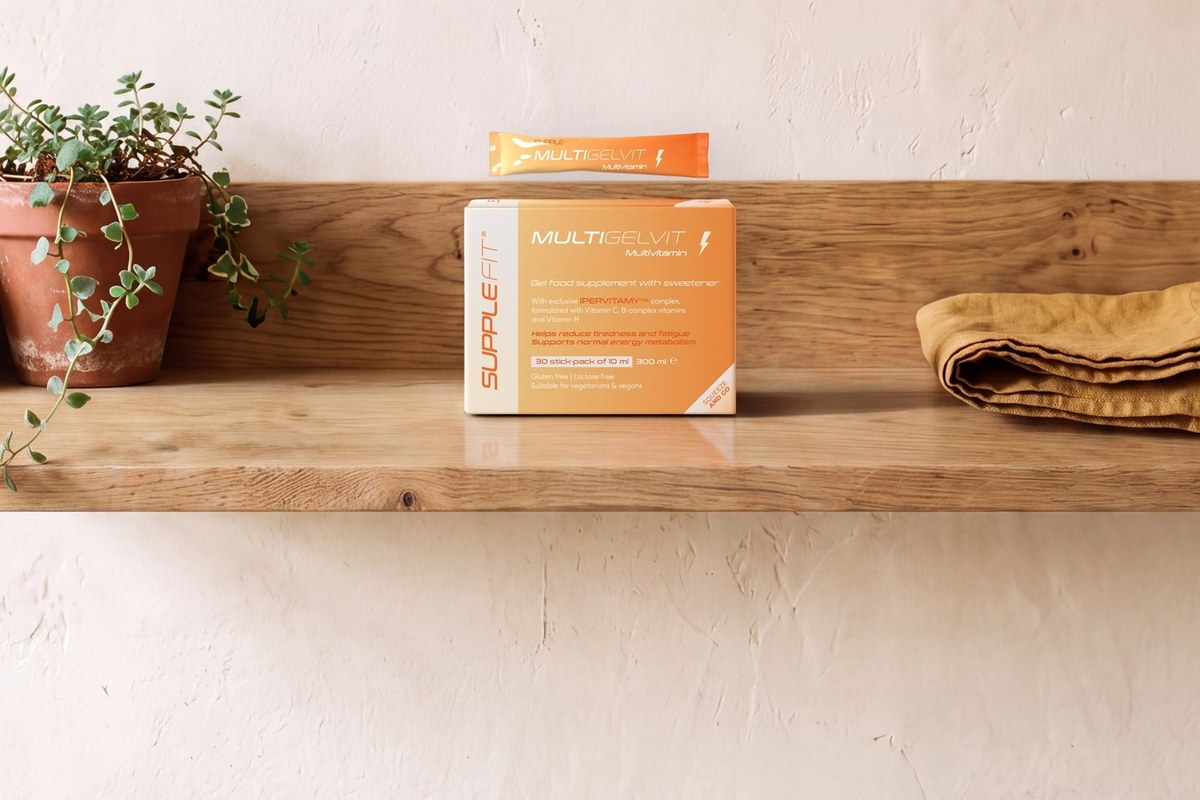
In this one you get the full set: B1, B2, B3 (niacin), B5, B6 and B12, plus vitamin C, biotin (vitamin H) and folic acid.
The approved wordings are short and specific:
Helps reduce tiredness and fatigue.
Supports normal energy metabolism.
“Reduce tiredness and fatigue” is a phrase with a legal definition, and it does not mean the gel replaces sleep. Nothing does. It means that these vitamins have a demonstrated role in normal energy metabolism, and that a deficiency shows up as exactly the sort of flat, blunted tiredness people describe.
Which leads to the thing worth saying plainly: if you’re not short of them, topping up won’t make you sharper than normal. Supplements fill gaps. They don’t create surpluses worth having.
Who this format suits
- People who dislike swallowing tablets, which is reason enough on its own.
- People who travel or eat breakfast on the move, where a glass of water isn’t a given.
- Vegetarians and vegans — this one is suitable for both, and gluten- and lactose-free.
- Anyone whose last three multivitamin jars are still in a cupboard, three-quarters full.
And who it doesn’t: anyone who wants a sugar-free supplement, since it’s sweetened; and anyone hoping a multivitamin will do the work of a varied diet. It won’t, and the label says so.
The practical bit
One box holds thirty sticks of 10 ml, 300 ml in total. Tear, squeeze, done.
For the dosing schedule, follow the packet you receive — I’d rather send you to the box in your hand than print a number here that might not match it.
Food supplements are not medicines and don’t replace a varied diet and a healthy lifestyle. If you’re pregnant, breastfeeding, taking medication or living with a chronic condition, talk to your doctor before adding anything.