9 August 2026
What to Look for on a Collagen Label (and What the Claims Actually Mean)
This article contains affiliate links. If you buy through them I earn a small commission, at no extra cost to you. It doesn't change what I recommend.
Two boxes of collagen sit next to each other. Both say “for skin, hair and nails”. Both show a woman with excellent skin. One costs three times the other.
Nothing on the front of either box tells you why.
This is a guide to the back — the part with the small print, where the actual differences live. By the end you’ll know which words mean something, which are decoration, and which one sentence on the label is the only claim European law allows anyone to make.
Let’s start with that last one, because it reframes everything else.
The claim nobody puts on the front
In the EU, a supplement can only make a health claim if that exact claim has been authorised. The list is public, it’s specific, and it’s shorter than the marketing suggests.
Collagen is not on it. Not for skin, not for hair, not for nails, not for joints. No approved claim exists for collagen as an ingredient.
So how do collagen products talk about skin at all?
Through vitamin C. Its authorised claim reads:
Vitamin C contributes to normal collagen formation for the normal function of skin.
That’s the sentence. It’s the only legal way the word “collagen” appears in a health claim in Europe — and notice what it actually says. Vitamin C helps your body form collagen. It says nothing about swallowed collagen doing anything.
This is why almost every serious collagen supplement contains vitamin C, and why the claim on the box is always phrased around the vitamin rather than the collagen. Once you see it, you’ll see it everywhere.
What to do with this information: don’t treat it as proof that collagen supplements are pointless — absence of an authorised claim is not the same as evidence against. Treat it as a filter. A product that quietly follows the rules and tells you what’s inside is being straight with you. A product promising to erase wrinkles by week four is not, and it’s breaking the law while it does it.
Hydrolysed, peptides, or plain collagen
The first word on most labels is hydrolysed (or “hydrolyzed”, or “collagen peptides” — the same thing said three ways).
Collagen in its natural state is a large, tough protein. Hydrolysis breaks it into much shorter fragments. Practically, this matters for two dull but real reasons: the short fragments dissolve, and plain collagen doesn’t. Try stirring unhydrolysed collagen into a glass of water and you’ll get lumps that survive the spoon.
If a label doesn’t say hydrolysed or peptides anywhere, that’s worth a second look.
Types I, II and III — and why the number matters
Collagen isn’t one substance. The label will usually name types, in Roman numerals.
- Type I — the most abundant in the human body. Skin, bone, tendon.
- Type III — sits alongside type I in skin and blood vessels; the two are usually found together.
- Type II — cartilage. A different product for a different purpose.
So a supplement aimed at skin, hair and nails typically states types I and III. One aimed at joints is usually type II. If a box says “for skin” and lists type II, someone has mixed up their own product line.
The source follows from the type. Bovine collagen gives mostly types I and III. Marine collagen — from fish skin — is mostly type I. Chicken collagen is mostly type II.
Which brings up a point of honesty most labels bury in the ingredients list: collagen is an animal product. There is no such thing as vegan collagen. Products sold as “vegan collagen” contain no collagen at all — they’re vitamin and amino acid blends intended to support your own production. That may be a perfectly reasonable thing to buy, but it is not the same product, and the naming is deliberately blurry.
If you eat no beef, check the source before you check anything else.
Molecular weight, in daltons
Some labels state a number in daltons (Da) — 2000 Da, 3000 Da, 5000 Da. Most say nothing at all, which tells you something in itself.
Daltons measure the size of the collagen fragments after hydrolysis. Smaller number, smaller fragments, better solubility — including in cold water, which is the difference between a supplement you take and one that sits in the cupboard because it clumps.
A stated molecular weight is a sign the manufacturer knows what they made. It isn’t a promise of results, and don’t let anyone sell it to you as one.
The number that isn’t what you think
Here’s where labels quietly mislead, and it costs people money.
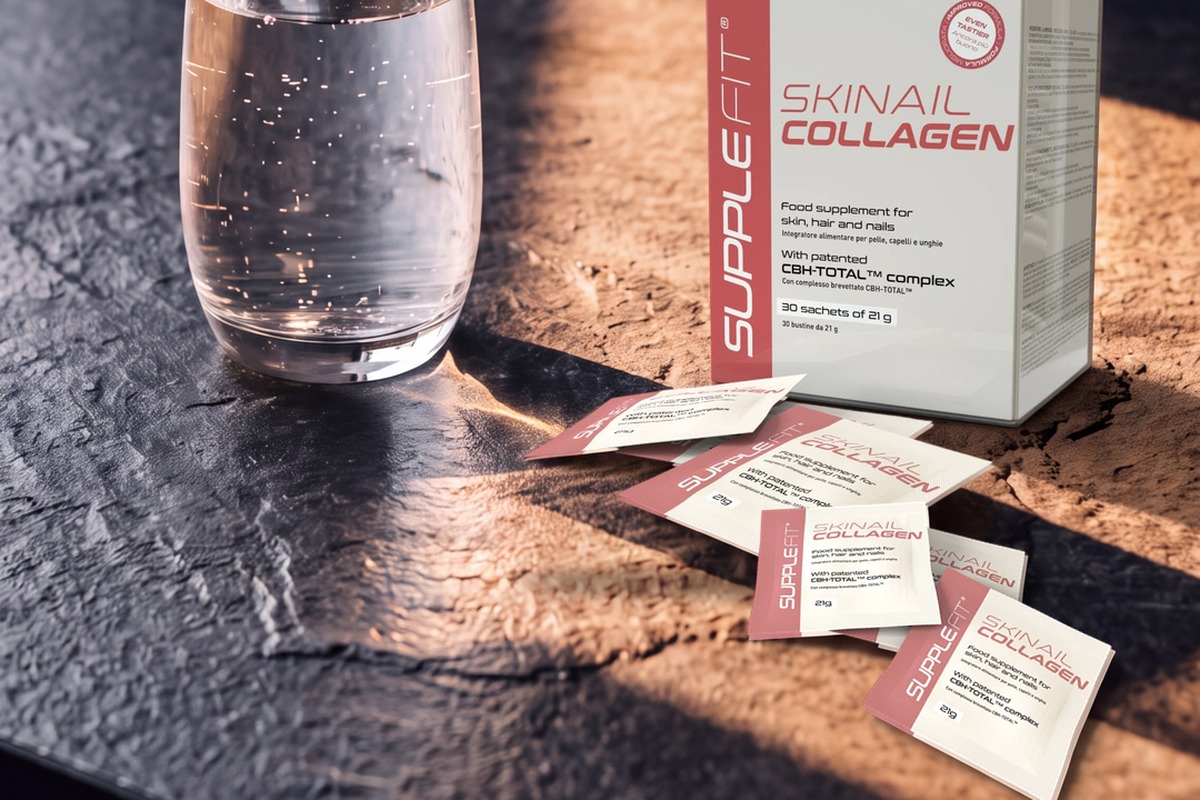
A sachet weighs, say, 21 grams. That figure is printed large. It is the weight of everything in the sachet — collagen, vitamins, minerals, plant extracts, flavour, sweetener.
It is not 21 grams of collagen.
How much collagen is actually in there sits further down, in the nutrition table, in small type. Sometimes it isn’t stated at all. When you compare two products, compare that line — not the sachet weight, and definitely not the box size.
The same logic applies across supplement shopping generally: identical price rarely means identical content, and the front of the pack is designed to stop you turning it over. We wrote about a version of this problem in our comparison of four aloe vera juices, where four bottles cost exactly the same and differ entirely in what’s inside.
What else earns its place in the formula
Beyond collagen and vitamin C, a few ingredients turn up repeatedly. These do have authorised claims, which is precisely why they’re there:
- Zinc — contributes to the maintenance of normal skin, hair and nails, and to the protection of cells from oxidative stress.
- Biotin (vitamin H, or B7) — contributes to the maintenance of normal skin and hair.
- B vitamins, including B12 — contribute to normal energy-yielding metabolism and to the reduction of tiredness and fatigue.
Fruit and berry extracts — pomegranate, blueberry, grape, acai, cherry — appear on premium labels. They carry no authorised claims individually, so treat them as what they are: part of the formula, not the reason to buy it.
How to actually take it
The practical part, which most articles skip:
Once a day. Morning or evening — there’s no rule that one beats the other, so pick whichever you’ll actually remember. Habits fail on complexity, not on willpower.
In about 250 ml of water, at room temperature. Good hydrolysed collagen dissolves even in cold water; if yours needs stirring and a minute of patience, that’s normal — natural formulas without anti-caking agents are slower to disperse. That’s a trade, not a fault.
Consistently. Collagen isn’t a painkiller with a same-day effect. Whatever you’re hoping for, it’s a matter of months, and it’s honest to say that upfront rather than sell you a fortnight.
With food, if you prefer. There’s no absorption reason to take it on an empty stomach, and the flavoured ones are pleasant enough to drink alongside breakfast.
A short checklist for the shop
Turn the box over and look for:
- Hydrolysed collagen (or peptides) — not plain collagen
- Types I and III if you’re buying for skin, hair and nails
- The source — bovine, marine, chicken — and whether it suits your diet
- Vitamin C in the formula — for the reason explained above
- Zinc and biotin, the two other ingredients with real authorised claims
- How much collagen per serving — not how much the sachet weighs
- Molecular weight in daltons, if stated — a good sign, not a promise
- A claim written in the careful language of the law. Extravagant promises mean the maker either doesn’t know the rules or has decided to ignore them. Neither is a recommendation.
The short version
Collagen supplements are not magic and they are not a scam. They’re a protein powder with a vitamin and mineral formula attached, and the honest sentence about them is the one European law allows: vitamin C contributes to normal collagen formation for the normal function of skin.
Read the back of the box. The front is advertising; the back is information.