10 August 2026
Deodorant With Alcohol or Without: How to Pick the Right One
This article contains affiliate links. If you buy through them I earn a small commission, at no extra cost to you. It doesn't change what I recommend.
Most people buy deodorant by smell. You stand in the aisle, uncap two or three, pick the one that isn’t unpleasant, and leave.
That works right up until it doesn’t — until the one you bought stings after shaving, or leaves marks on a dark shirt, or stops feeling like enough by mid-afternoon. Then you buy a different one, more or less at random, and hope.
There is a better way to choose, and it comes down to a single question that almost no label asks you directly: do you want alcohol in it or not?
Everything else follows from that. But before we get there, we need to clear up the confusion that makes half of these purchases go wrong.
Deodorant is not antiperspirant
These are two different products solving two different problems. Shops shelve them together, which is why almost everyone conflates them.
An antiperspirant reduces sweating. It works with aluminium salts that temporarily narrow the sweat ducts. Less sweat comes out. That’s the mechanism, and if a product doesn’t contain aluminium salts, it is not an antiperspirant, whatever the front of the pack implies.
A deodorant does nothing to sweat. It works on smell.
And here’s the part worth knowing, because it changes how you think about the whole category: sweat itself has essentially no odour. What comes out of your skin is mostly water and salts. The smell appears afterwards, when bacteria that live on the skin break that moisture down. The odour is a by-product of bacteria, not of sweating.
So a deodorant has two honest jobs: make the surface a less comfortable place for those bacteria to multiply, and leave a clean scent while it does it.
This matters practically. If your complaint is “I sweat too much”, a deodorant is the wrong product and no amount of reapplying will fix it. If your complaint is “by the afternoon I don’t feel fresh”, a deodorant is exactly the right product.
Neither is a treatment for anything. Persistent, heavy sweating that interferes with your life is a medical matter, and a can from a shop shelf is not the answer to it.
The actual fork: alcohol or no alcohol
Now to the question that decides which one you should own.
What alcohol does
A hydroalcoholic formula — the wording you’ll find on the back of most sprays — means water and alcohol are the base the active ingredients sit in.
Alcohol earns its place for three reasons:
- It’s antiseptic. It makes the skin surface immediately inhospitable to the bacteria that produce odour.
- It evaporates fast. That’s the cool, dry, instantly-fresh feeling a spray gives, and why you can dress within seconds of applying it.
- It carries scent well. Fragrance disperses evenly and stays put rather than sitting in a heavy patch.
The trade-off is straightforward: alcohol is drying, and on skin that is already irritated it stings. Everyone who has sprayed a deodorant onto freshly shaved skin knows this within about half a second.
Alcohol suits you if: you want speed and a clean, dry finish; you apply in the morning and want to be dressed immediately; your skin is normal and not reactive.
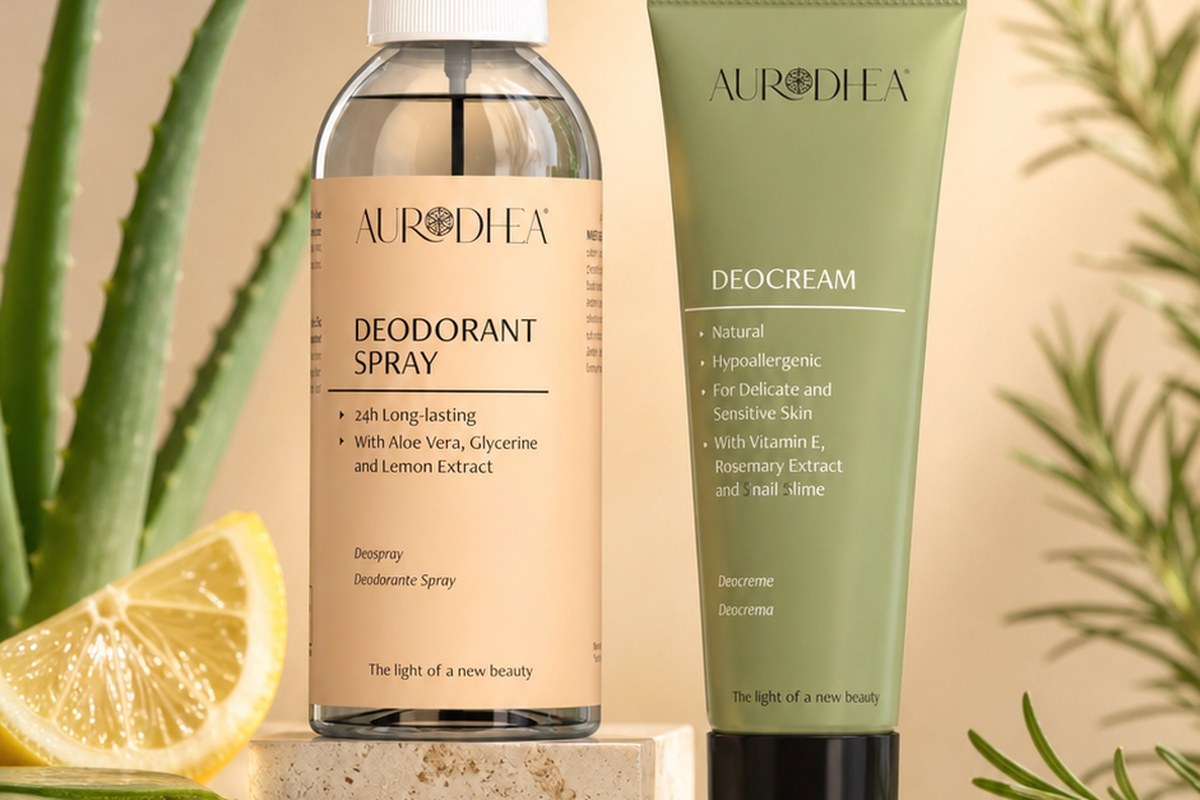
A good spray in this category will pair the alcohol with something that softens it. The AURODHEA spray, for example, uses aloe vera extract, glycerine and lemon extract alongside the hydroalcoholic base — aloe and glycerine to moisturise and soothe, lemon for freshness. It forms a protective film on the skin, helps prevent the multiplication of odour-causing bacteria, and is stated to keep you fresh for 24 hours. It’s dermatologically tested.
What no alcohol does
An alcohol-free formula is usually a cream or a stick, and it works differently. Nothing evaporates; the product stays on the skin as a thin layer and does its work there.
You give up the instant cool hit. In exchange you get something that doesn’t sting, doesn’t dry, and can go onto skin that has just been through a razor or wax.
No alcohol suits you if: your skin is delicate, sensitive or reactive; you apply after shaving or waxing; sprays have irritated you before; you dislike aerosols on principle.
The AURODHEA deocream sits here — 50 ml, no alcohol, described as a natural and hypoallergenic formula for delicate and sensitive skin, with vitamin E, rosemary extract and snail mucin. It’s light, absorbs quickly, leaves no marks, and is suitable for skin irritated after depilation. Also dermatologically tested.
A word on that ingredient, because we’d rather say it here than have you discover it on the tube: snail mucin is exactly what it sounds like — snail secretion filtrate, a long-standing ingredient in soothing skincare. Some people seek it out. Some are put off. Both reactions are reasonable; what isn’t reasonable is a brand hiding it in the small print.
And one honest note on “hypoallergenic”. It means a formula built to minimise the risk of a reaction. It does not mean nobody can react to it. No product can promise that, and one that does is overselling.
Choosing between them, in one line each
- Fast, fresh, dressed in ten seconds → the spray
- Just shaved, sensitive skin, no sting → the cream
That’s genuinely the whole decision. Neither is the better product; they answer different questions, and plenty of people end up owning both — spray on ordinary mornings, cream on the days they’ve shaved.
Marks on clothes, and where they come from
The white streaks on a dark top and the yellow patches on a white one have different causes, and it’s worth knowing which is which.
White marks are usually the product itself — too much applied, or applied and dressed over before it dried. Less product, a few seconds’ patience, and both largely disappear.
Yellow patches on white cotton are typically a reaction between aluminium salts and sweat. That is an antiperspirant issue, not a deodorant one. If you’ve been fighting yellowed armpits on your shirts, switching from antiperspirant to deodorant is a real fix rather than a workaround.
A “leaves no marks” claim on a pack refers to the first problem, not the second. Still useful, but know what you’re being promised.
How to read the back of the pack
Turn it over and look for these, in this order:
- Deodorant or antiperspirant? If the ingredients list no aluminium salts, it’s a deodorant — regardless of what the front suggests. Know which one you’re buying.
- Alcohol or not. “Hydroalcoholic”, “alcohol denat.” — that’s the fork from this article. It should be a decision, not a surprise.
- What softens the formula. Aloe, glycerine, vitamin E, plant extracts. In an alcohol formula, these are what keep it from drying you out.
- How long it claims to last. 24 hours means 24 hours from application on clean skin. It doesn’t survive a gym session, and it isn’t a promise about the shirt.
- “Dermatologically tested.” It means the formula was tested on skin under supervision. It is a reasonable sign of care. It is not a guarantee that your skin will like it.
- The fine print you’d rather not read. Snail mucin, fragrance, the full ingredient list. Whatever your feelings about any of it, better to meet it here than after delivery.
- Claims that sound like medicine. “Cures excessive sweating”, “kills 99.9% of bacteria” — a maker willing to write that is either unfamiliar with the rules or ignoring them. Neither inspires confidence in the rest of the label.
What we’re allowed to say, and what we aren’t
We keep to this on every product we write about, and it’s worth stating plainly.
We can tell you what’s in a formula, what the manufacturer states about it, and what it’s designed for. We can’t tell you it will cure anything, stop you sweating, or fix a medical condition — not because we’re being coy, but because those claims aren’t permitted and, more to the point, aren’t true of a deodorant.
The same principle runs through everything on this site. We wrote about it at length in our guide to reading a collagen label, where the gap between what a box promises and what the law allows is even wider.
The short version
Sweat doesn’t smell; bacteria do. Deodorant handles the smell, antiperspirant handles the sweat, and they are not interchangeable.
Once you know that, the choice is one question: alcohol for a fast, dry, immediately fresh finish — or no alcohol for skin that’s sensitive or freshly shaved.
Pick by the day you’re having, not by the packaging.