6 August 2026
Aloe Vera Juice: How Much to Drink, When, and What to Check on the Label
This article contains affiliate links. If you buy through them I earn a small commission, at no extra cost to you. It doesn't change what I recommend.
Aloe vera juice is one of those products people buy on impulse and then leave in the fridge, because nobody told them what to actually do with it.
How much? Before food or after? Why is there sediment at the bottom? And why does one bottle cost three euros and the next one twenty-five, when both say “aloe vera” on the front?
This guide answers those questions in order. It isn’t a list of miracle claims — there are enough of those already, and most of them don’t survive a close look. It’s the practical part: what to buy, how to drink it, and who should leave it alone.
First, what aloe vera juice actually is
Cut an aloe leaf across and you’ll find three distinct layers, and the difference between them matters more than any marketing on the bottle.
The inner gel — the clear, slightly slippery flesh in the centre. This is the part used in drinkable aloe. It’s roughly 99% water, with polysaccharides, some vitamins and minerals in the rest.
The pulp — small pieces of that same inner leaf, left in rather than filtered out. Products that keep the pulp have a texture; fully filtered ones are clear like water.
The latex — a bitter yellow layer sitting just under the skin. This is where a compound called aloin lives, and it’s a powerful stimulant laxative. Not a subtle one.
That third layer is the reason quality varies so wildly. Properly made aloe juice is produced from the inner leaf with the latex removed. Cheap production is less careful.
The one thing to check on the label
If you take a single thing from this article, take this one.
Look for inner leaf or decolourised aloe, and check that the aloin content is declared as minimal or absent. Reputable producers state it.
There’s a regulatory reason behind this. In 2021 the European Union prohibited hydroxyanthracene derivatives — the aloin family — in food supplements, following a safety review. Aloe products sold legally in the EU are made from the inner leaf with these compounds removed. If a bottle is vague about which part of the plant it uses, that vagueness is information.
The other things worth reading on the label:
- Percentage of actual aloe. “Aloe vera drink” can legally mean 10% aloe and 90% water with sugar. Look for a stated figure — the good ones say 99% or higher.
- Sugar. Aloe is bitter, and the cheapest way to fix that is sugar. A “healthy” aloe drink with 12 g of sugar per glass is a soft drink wearing a costume.
- Concentrate or not. A double concentrate goes further per bottle, which changes the real price per serving considerably.
How much aloe vera juice per day
This is the most searched question about aloe, and the honest answer is: follow the bottle, because concentrations differ enormously between products.
That said, here’s the shape of it for a standard inner-leaf juice:
25 ml, diluted in 500 ml of water. That’s the usual serving for a concentrated product. If you prefer a stronger taste, use less water — 200 to 250 ml makes a more noticeable drink, and plenty of people take it that way.
Once a day. That’s the dose on the data sheet of the 99.9% juice: 25 ml a day in total, not 25 ml three times. (The organic filtered juice is dosed differently — 30 ml, two or three times a day.)
Before a meal. The data sheet says preferably before meals, and it’s also the easiest way to build a habit: it attaches the drink to something you already do every day.
Shake the bottle first. Always. The pulp settles, and an unshaken bottle gives you water at the top and everything else at the bottom.
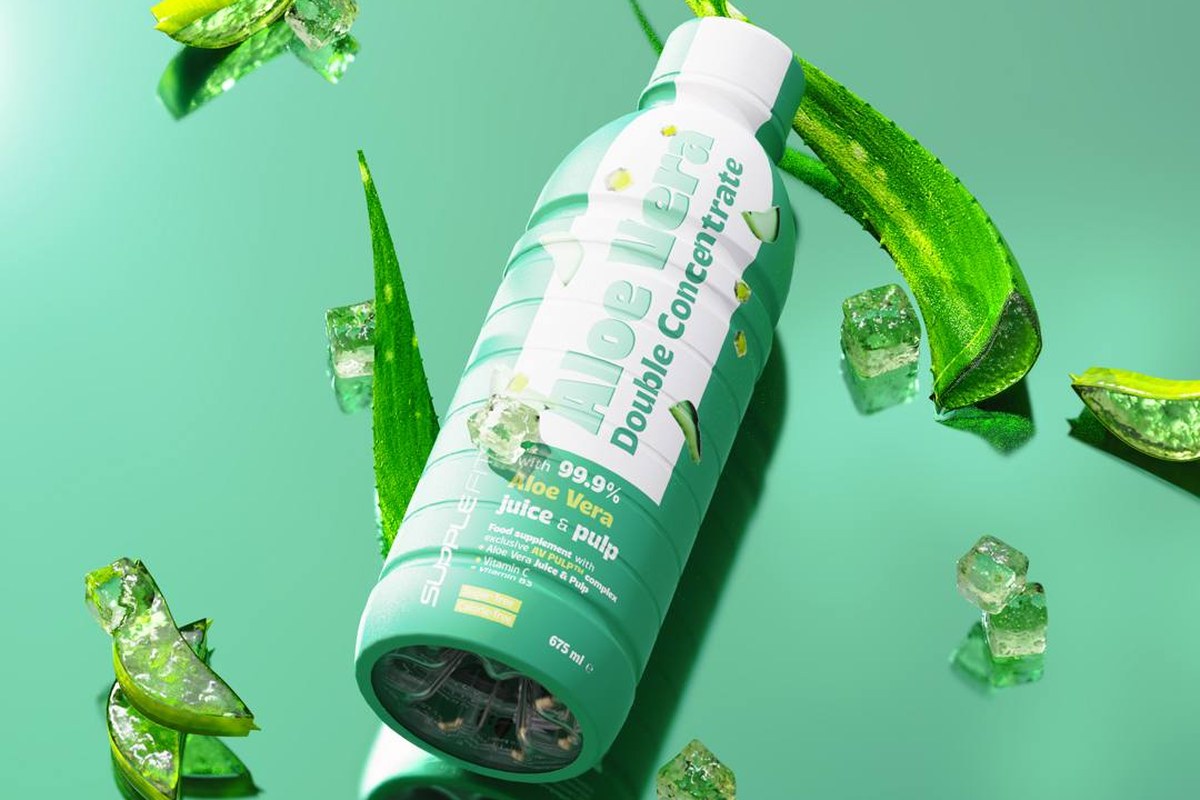
A concentrated 675 ml bottle at 25 ml per serving works out to 27 servings — close to a month if you take it once a day. Worth doing that arithmetic before comparing prices between brands, because bottle size alone tells you very little.
What it does — and what it doesn’t
Here’s where most aloe articles go off the rails, so let’s be precise.
Aloe vera has a long history of traditional use, and it’s a pleasant, calorie-free way to drink more water. What it is not is a treatment for anything. If you see claims about detoxification, curing conditions or flushing toxins, close the tab — the liver and kidneys handle that, and no juice reassigns the job.
Where there is documented, regulator-approved substance is in what gets added to the better aloe drinks:
- Vitamin C contributes to the normal function of the immune system, to normal energy-yielding metabolism, and to the reduction of tiredness and fatigue.
- Niacin (vitamin B3) contributes to normal energy-yielding metabolism and to the maintenance of normal skin and mucous membranes.
Those are approved health claims with actual evidence behind them, which is why they appear on labels in specific wording. It’s a smaller promise than “aloe transforms your health” — and it has the advantage of being true.
As for digestion: many people drink aloe because they find it settling. That’s a reasonable personal reason to drink something. It just isn’t a medical claim, and anyone presenting it as one is going further than the evidence does. If digestion is your actual concern, the foundations do more — see the guide to foods for gut health for where the real leverage sits.
The sediment question
Open a bottle of pulp aloe, hold it to the light, and you’ll see particles suspended in it, with more settled at the bottom.
That’s the pulp. It’s supposed to be there — it’s the part of the leaf that wasn’t filtered out, and in a pulp product it’s what you’re paying for. Natural ingredients separate. A juice that stays perfectly uniform for eighteen months has usually been engineered to do that.
Shake, pour, drink. What you should never ignore is a bottle that smells fermented, tastes fizzy or has a bulging cap — that’s a different situation entirely, and it goes in the bin.
Storage: refrigerate after opening and use within the window on the label, usually four to eight weeks. It’s a natural product without heavy preservatives, which is the point, and which is also why it doesn’t live forever in a warm cupboard.
Who shouldn’t drink it
Short list, and worth taking seriously:
- Children under 12.
- During pregnancy or breastfeeding.
- Anyone with a chronic condition — check with your doctor first, particularly if you take regular medication. This matters most for diabetes medication and diuretics.
If you’re simply new to it, start with half a serving for the first few days rather than three servings on day one. Introduce it the way you’d introduce any new food.
How to fit it into an ordinary day
The version that survives contact with real life:
Morning, before coffee. 25 ml in a glass of cold water, with lemon and mint if you want it to taste like something you look forward to. Thirty seconds to make. It also front-loads a glass of water before the first coffee of the day, which is quietly the most useful part.
That’s it. One habit, attached to one you already have.
The versions that don’t survive: three servings a day at scheduled times, or a drink you have to remember separately from everything else. Anything requiring willpower at 7am on a Tuesday in February is not a habit, it’s a project.
The one I drink
For transparency: the aloe I keep in my own fridge is 99.9% aloe vera juice and pulp with the AV PULP™ complex, plus vitamin C and vitamin B3. Sugar-free, calorie-free, 675 ml, which is 27 servings of 25 ml.
It meets the criteria in this article, which is the reason it’s the one I use rather than the other way around. If you find something that meets them at a better price, buy that instead — the checklist matters more than the brand.
There are three more aloe drinks in the same range, all at the same price, and which one suits you depends entirely on what’s in it.
The short version
- Buy inner leaf aloe with declared aloin removal and a stated aloe percentage.
- Check the sugar. Bitter is normal; sweet is a red flag.
- 25 ml in 500 ml of water, once a day, before a meal.
- Shake the bottle. Sediment is pulp, not spoilage.
- Refrigerate after opening.
- Not for children under 12, pregnancy or breastfeeding; ask your doctor if you have a condition.
Aloe vera juice isn’t going to change your life. It’s a decent, sugar-free way to drink more water with something in it — and bought properly, it’s a pleasant one. That’s a smaller claim than most of the internet makes, and it’s the one that holds up.
Food supplements are not medicines. They do not replace a varied diet and a healthy lifestyle. Not recommended for children under 12, during pregnancy or breastfeeding. If you have a medical condition or take medication, speak to your doctor.